Showing posts with label travel to the Philippines. Show all posts

Sunday, April 22, 2018

Home


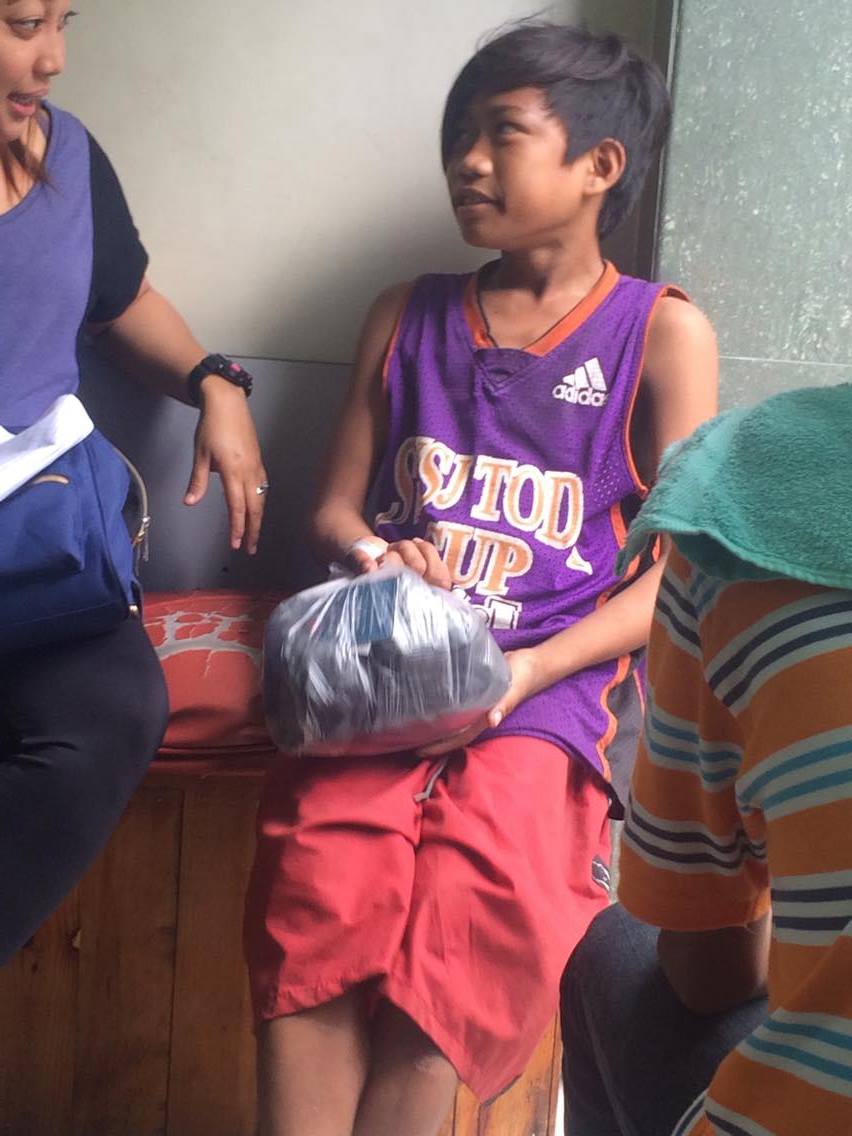
Taken the first time we ever saw him


The first time I ever saw Adonis he was high. We were having a medical outreach and feeding in his city, sponsored by a friend from North Carolina. There was spaghetti, chicken, hygiene kits  and candy given to more than 100 street children.  There were testimonies shared, prayers prayed and lots of hugs and medicine handed out to some pretty neglected kids. And then it was time to clean up and go home.  But at the very end of the program, one of our Mercy House boys came to me and  said "Can my cousin come and live with us?".  I had almost gotten away. Almost.

But he introduced me to the child in the photo above. 

I could tell he was on some sort of drug by his behavior - lots of laughing and smiling. He could not focus on what I was saying. He stepped outside my direct line of sight and peed on a wooden post about two feet from me.   And I was  a little scared of him.  He was 15 years old -  older than any other children we had at the time - and he was clearly saturated by street life in a "leveled up" way from that of our other clients.  So I asked him to add me on facebook (as most street children here have a facebook account that they check often from the internet cafes when they can find the money), assuming he would lose the scrap of paper I had written my name on for him,  and I left him there in the city, a little relieved that I didn't have that "heart tug" that so often knocks me over when I  meet a child we are supposed to invite into our Mercy House family. 

But by the time I got back to the  center, a friend request from Adonis was in my computer.  And a long message written by a different street child informing me that Adonis could not read or write but he would really like to come and live with us, go to school and "fix his life".  The friend shared with me that Adonis has bad asthma and was sick a lot and that he would be "a good boy" for me.  I laughed.  Because I had heard that before and the kids promising they were "good boys" were almost always the worst behavior problems.  I was getting jaded. Or experienced. Or both. 

So, I lay down that night in my bed to pray for the kids we had served that day and to ask the Lord what to do now for specific children. And the words  "go get Adonis" kept coming to mind. I think I said "NO WAY" out loud. And I tried to reason it was not the prompting of the Lord but  my own "savior complex" putting that thought in my head.  I tried to focus on the foolishness of accepting a child that old with that many issues into our center. But that nagging. It would not go away.  And  I knew. 

The following day, I asked our social worker to call the city social worker from Adonis' town and ask about him. She BEGGED us to come and pick him up. She shared the problems he caused in the street,  the stealing and vandalism. The bullying of younger children, the constant use of drugs in public - and so much more.   So, with more fear than faith, we  went to his city to ask him if he was serious about changing his life.


Admission Day
He came into our center and slept for about three days, ate an inordinate amount of food and began to be more "himself" as the substances he relied on to keep him feeling strong and happy wore off. 

And for about 5 months, he did well with us.
Until he didn't. 

A few months after leaving Mercy House


He began to miss the drugs, the computer shop, the girls, the begging and the money. So he began to act out inside the center - disrespecting staff, bullying other children, anything to draw attention to himself  and disrupt whatever activities were going on.  So we counseled him regularly about his actions. We prayed with him and for him. But, eventually, he insisted that we get him back to his city of origin or he would just run away.  So with the cooperation of the local government and Adonis' birth mother, we reunited him with a very fragile family that we knew would not  be able to handle him.
Sadly, we were right. He was in the street again. 

Within a week, Adonis was messaging us asking if he could come back into our home.  But upon his leaving, our Mercy House boys began to share with us some pretty extreme things Adonis was doing while living with us- things they were afraid to disclose until he was gone.  So we went and met him face to face to let him know we could not take him back and why, but we would help him find a place if he was open to another home. 
We found him in the street easily as everyone in that city knows him. He was having an asthma attack and had no medicine so, we immediately  bought two inhalers, one for him to keep in his pocket and  one for the city social worker to keep in her desk and give to him when the first ran out. She agreed to do that for us.  
We fed him lunch and then he fell asleep on a city park bench, head on my lap, and all I could do was put my hand on his and pray silently - for his protection, for a center that could handle all the behaviors and keep their other kids safe, for the God who made Adonis for a bigger purpose to begin to reveal to that young man that he was created for so much more than the life he was currently living.  And then, with heavy hearts, we left him there to search for a place that could handle this difficult boy with the beautiful heart.  We had seen so much in him that was worth saving. So many sweet moments and protective instincts toward our staff.  

Enter: Kid's Home International.  Pastor Raffy Sison and his staff were introduced to us by an Action International missionary, my friend Erin.  Pastor Raffy runs a tight ship. He serves older boys 15-18 and some have committed serious offenses. He opened his home to Adonis and we were beyond grateful! Adonis thrived there. He learned to read. He learned to handle the word of God and serve in outreaches. He learned to hand wash his own clothing and take responsibility for himself and, best of all to us, he was only about 15 miles from Mercy House so we were allowed to visit him there. 
For 11 months, Adonis did well in the program at Kid's Home  but eventually approached Pastor Raffy and asked if he could be excused from the program. He  had asked that in the past but always changed his  mind after some counseling.  This time, it was different. Pastor Raffy texted Mercy House and shared with us that Adonis wants to return to us and he was 100% certain this time that he wanted to leave Kid's Home.  

I would be lying to say I wasn't at least a little thrilled at the prospect of getting him back.  

We missed him. Visiting him at KH and seeing his growth and maturity were highlights of our days. Knowing he was in the perfect place for him - the safest and most Christ-focused place he could have asked for - was the answer to so many prayers for that young man. But hearing he wanted to come back to us  and was now more READY was also an answer. 
So we went and got him. And brought him home.  He is now 17 years old and no longer the skinny, hyper active, drug dependent kid we met two years ago on the streets of his city.  He's a young man who is showing himself to be a good big brother to the kids here at Mercy House. He leads devotions. He helps the staff with any heavy lifting or labor-intensive jobs without being asked. And, my goodness, that sense of humor and smile just light up this place.

How did we make it for so long without him?   

And I share this for a few reasons. First, just to flat out spread the joy we have at being given a second chance with this boy. Second, to thank Kid's Home and Pastor Raffy and his staff a MILLION TIMES OVER for taking a chance on Adonis and for also being willing to give him back after  they all did so much of the hard work it took to get him to be the young man we see before us: changed by the power of God and looking more like His Son than we imagined he could.  
And third, I share this because all of  you who pray for and support Mercy House have a hand in the redemption of this boy .  And, people, if this was the ONLY child we served in our whole ministry. It would still be worth  the leaving and the selling and the coming across the ocean.  The resources we have invested to visit him, buy medicine and now to care for him every day come from those of you with a heart for street kids and the gospel.  And we can not express well enough how valuable you are.  
We eagerly await the rest of this story. We are not naive enough to think it will be smoothing sailing for the next couple of years and then Adonis lands that corporate job and rides off into the sunset to live "happily ever after".  Kids with rough beginnings tend to have a lot of extra work to do just to rise to the level of average kids in intact families.  But we put all of our trust in our Great Great God, to show us how to meet this young man's needs day by day. Step by step. Walkng by faith and expecting the Lord to keep every promise He has ever made. Because He will. 
So, for now, we are just raising a son who is right where he is supposed to be at this time in his life. 
And we are grateful to everyone who has poured into him and cheered him on along the way.
Playing Ball at Mercy House 

Hanging out with two of his Mercy House brothers


Add Adonis to your daily prayers, please!  He has a long way to go academically and spiritually before he will be ready to face the adulthood that lies just around the corner.  And while you pray, thank the Lord for  calling so many to serve just the one. 

More than we ask or imagine!  That is our God!

Sunday, February 5, 2017

Broken World


The world is broken. When sin entered this place in the Garden of Eden and everything straight was made crooked, there was nothing mankind to do to help itself. 

None of us is immune to the pain that living on a broken planet delivers. 

We have all been injured.
Remember hurtful words thrown your way? Betrayal by a spouse or family member ?
Someone you trusted sharing your secret pain for his own gain?
Injustice and prejudgement directed at you in times you had no power to defend yourself?

But we have also caused injury.
We have gossiped. We have chosen to believe gossip. We have lied.
We have stolen. We have been prideful and smug when humility was called for.
We have hidden behind the name of Jesus in an effort to avoid reaching out to people who live their sin out loud and proud. We have kept a record of our own good deeds and trotted them out when it suited us. We have been silent when we knew we should speak. 
In short, we have inflicted harm on other human beings. Sometimes on purpose and sometimes by accident .


The child in the picture above is almost sixteen years old! He is about 4 feet 6 inches tall and weighs 64 pounds. He is a severe asthmatic and has been in the street for many many years. Abuse at home drove him into the street as a young child and there he remained, fashioning a sort of family for himself out of other street children.   We met him at an outreach in his city at Christmas time and we had no space for a new child at the time. To be honest, I was also a little afraid to admit him, although he asked very respectfully.  We have met MANY respectful, adorable, endearing children only to discover AFTER admission that they are way too much for us in every way imaginable. 
But this child, who can neither read nor write, found me online and had a friend write me a plea to help him. 
And then the city social worker formally referred him to us. Whether he asked her to or she just happened to choose him from the scores of street children in their city who need help, we have not quite deciphered.  All we know is this child kept coming up in our work and we could not ignore him. We told him the date we would be in his town and he messaged again the day before asking if we were still coming. My heart could barely cope with this kind of hope being placed in us. 
He was asking for rescue from a life that was too hard for too long. Sin broke his world and he was asking us to help do some mending. 
And, for us, saying "no" would have been sin. 

"And to him who knows the good he ought to do and refuses to do it, for him, it is sin"
James 4:17


And just like with all of our children, as they start to trust us a little and they start to open up, we learn details that are crushing. 
Our children have been the recipients of some pretty shabby fallout from the sin of others.
And sometimes they have been the ones to injure others.

The challenge for us as a ministry is to seek the Lord daily for wisdom in helping these children "unlearn" the imprinted habits in their minds and focus on living lives that please God rather than self.

Ironically, it's the same challenge we face on a personal level every day. Even as long-time followers of Christ who are educated in His word and know how He calls us to live. 

We, as missionaries, are not immune to the effects of this broken world. Much to the contrary, we often feel like weary soldiers trudging uphill with a very heavy pack at the end of a day of fighting. 

We are attacked from inside and outside.  And sometimes we lash back. Sometimes we fail at loving like Jesus.  But when we succeed, we give Him the credit.   He works in us as He sees fit.

And in the first sentence of this post, I typed the phrase "there was nothing mankind could do to help itself."  That sounds awfully hopeless.  But here is where what appears to be bad news is actually good news. The best. 

No, we can not free ourselves from the bondage of sin. We can not free other people. We can not stop the cycle of sin in the lives of the children we serve. 

BUT JESUS CAN. AND HE DID. AND HE WILL. 

The only hope for any of us, on any side of the social justice equation in this sin-sick world is Jesus Christ. Only He can forgive. Only He can restore. Only He can make us whole and fill those empty places in us that we seek to fill with lesser things. 

In the light of these truths. We are all on an equal playing field. Pope and missionary and street child and perpetrator.  We all need Jesus. 

Do you know His forgiveness? Have you been restored? Are you seeking to fill your life with lesser things and wondering why they never satisfy?  Only He can truly satisfy your soul.

Sometimes I make the mistake of believing this blog is only read by Believers, firm in their faith. But it dawned on me that I have not shared the gut, core, baseline reason for the work we do here. 

It is all about Jesus. His rescue of us from our own sin. His ongoing sanctification of us. His patient forgiveness of our blatant rebellion. His sacrifice that fills us with the hope that we can turn and offer to others. 

So, precious reader, if you have any questions about your own place with Him. About your position as forgiven, unforgiven, unrepentant or made new, please PLEASE reach out to someone you know as a trustworthy follower of Christ. Or email us (nikki@mercyhouseph.org) and ask those questions that have plaguing you about your own salvation.   

He loves you.  

"And THIS is love, not that we love God but that He loved us and sent His son as a payment for our sins".   1 John 4:10 


Friday, November 20, 2015

Squeezed and Molded: THE EARLY DAYS


Adoption is hard.  If you don't think so, you probably haven't done it.

And I'm not talking about the waiting and the fund raising and the endless prayers and worries and email checking and agency calling. Yeah. That's hard, too.

I'm talking about the ACTUAL bringing of a new child into an already-functioning family.
It's hard.  Pretty much for everyone. It's also amazing and miraculous. Even in the hard parts.

Before my family's move to The Philippines to start our own child caring agency, I was called on often by the adoption agency we used in the US to adopt our own four sons, Christian Adoption Services.  I was called on to mentor or walk with families who had just brought their children home and were struggling with some aspect of the transition.  I loved that ministry. I saw good fruit as families "got the hang of it".

I struggled with our own transition.  ALL FOUR TIMES.  Sometimes the struggles were tiny but often they were big.  And, don't get me wrong, I loved my sons. I wanted them. I would not have given them back for all the tea in China.  Most days.

If you are reading this and your adoption has been EASY, please bow your head right now and thank God for that. You are in the minority. In fact, I have never met anyone like you.  Every family who has ever confided in me about the early days of their adoptions sang very similar songs:

"This is hard"
"Why do I feel this way?"
"What have we done to our family?"
"I'm tired".

But those same families expressed peace and the deep knowledge that they were all right where they were supposed to be, on the many good days post adoption. 
 
I believe there are several reasons that the early days of adoption are hard for most families.  And I believe it is NORMAL for adoption to be "hard" in many aspects.
 
If it were easy, everyone would do it.
 
1. Unmet Expectations:  Before our children are home, we build a fantasy around them. We imagine how they will sound, feel, react and even smell.  And it is almost never a true picture.  Our fantasies rarely include the nitty gritty about another human - handling his dirty laundry, bathroom accidents, bad breath, rotten teeth or tantrums, poor sleep patterns,  "weird" eating habits and the time it takes to just warm up to another person.  These can all be big wet blankets on the party that has been going on in our minds for upwards of a year. 
Suggestion: start BEFORE your child comes home imaging him as a child who might struggle. Think of ways you will comfort him when he's crying for no reason. Make a plan, ON PAPER of some strategies you will use if he clams up and won't speak to you for a little while. Put into place a  "go to" plan for your other children if they encounter any negative behaviors in their new sibling that they are worried about. Include the whole family in these discussions of "what if . . .".  It may feel like focusing on the negative when what we really want to do is float on a cloud of dreamy love.  But, trust me, it will help balance expectations and give everyone a plan of action if early struggles crop up.  It will also paint a picture of the child as a regular child with regular child behaviors.
 
2. Sheer Exhaustion: If your child is from another time zone and he's not sleeping in your time zone, everybody pays.  If you traveled around the world to fetch him and you had to "hit the ground running" when you returned home, everybody pays with interest.  
Suggestion: REST together.  If your child naps at noon, have the whole family get some quiet time. The temptation to do laundry and clean house while he sleeps will be there. If you can afford to hire help for housekeeping, do it for the first month. If not, pace yourself and prioritize sleep over housework. I know, easier said than done . . .
From 3pm on, plan activities that will keep everyone awake. Take walks, color and draw together, sit in the grass outside and look for bugs and birds, play board games and cards - anything to stay awake until dinner, bath and bed time.  
If you are a rigid "everyone in his own bed" parent and your new child is afraid, you may have to take a 30-day break from your rules and make him a pallet in your room. When everyone establishes a sleep schedule and catches up from the trip and transition, feel free to get tough again. In the meantime, grace, grace and more GRACE.
 
3. Your Other Children:  If you have other children in the home when you adopt, there is a whole new dynamic to explore. Jealousy, new bonds, a pecking order and Mama and Papa spreading themselves  thin trying to  spend quality time with every child - all stones in the heavy bucket of adoption transition.  But there is HOPE .  . .  read on! 
Are your other children old enough to start learning to put other's needs ahead of their own? If they are not babies or toddlers, they are!  Explain to them BEFORE your new child comes home that "new sister will need extra time with Mama and Papa when she is still new. You might have to share us more than you want to. "   And do not let the guilt of the slightly unbalanced, TEMPORARY shift in focus drag you under the waves.  With some conscious effort, you will be able to regain more balanced parenting in a month or two.  And, depending on how you have parented your other children prior to adoption, a little dose of "it's not always about ME" might do everyone some good.  It always did in our own family. Selflessness in not natural to any of us and adoption is a good way for ALL of us, parents included, to get a crash course.  Painful though it is.
 
4. Too Much, Too Soon: Everyone wants to meet your new child. They donated to your adoption fund, they prayed, they listened while you cried during the wait, they dog sat while you traveled, they DESERVE to meet him.  The pressure of those meetings takes a toll on the family and the child. Nobody's comfort matters as much as that of your new child during transition. If the friends and family have to wait, graciously tell them via a blanket email, facebook status or quick phone call that you are having adjustment time and will see them as soon as you can. Assure friends and family that you are planning a drop in day that will be announced as soon as everyone feels human again!
 
5. Feeling Isolated: Do you have anyone you can really trust and talk to about your struggles in early adoption? Let's see . . . the family members who discouraged you from adopting in the first place would just say "I told you so" so, no. Not them.   The friends and family who are encouraging and supportive but have never adopted may listen and pray but will they really UNDERSTAND?
The ladies Bible study you stood before sharing about the beautiful picture of the gospel that IS adoption - they might be a good place to start but will you scare them out of adopting someday? Hard to say. 
You and your spouse may be on the same page but, if not, the last thing you want to do is discourage the one you are expecting to keep you somewhat afloat.    Are you both struggling?
The FIRST and BEST place to go for encouragement and help is to your knees.  Seek the face of God. Tell Him your struggles. He already knows them.  Ask Him to keep your heart focused on the "bigger picture".  Read His promises. They are no less true than they were before you added to your family.
 Chances are, you have at least one close friend who has adopted a child and who would walk with you through your transition time - the joys and the pain.  If not, call your adoption agency and ask for a mentor. Get into an online/ facebook adoption group and observe at first. Is this group sharing REAL or just FLUFFY? If they are open about their ups and downs, you have hit paydirt.  Stay there, share, read, support each other.  Someday YOU will be that family walking others through their transition time with assurances that "this, too, shall pass".  And it will. 
 
6. Borrowing Trouble:  You read so many adoption books prior to bringing your child home that you are now on the lookout for the symptoms of the disorders the authors specialize in.  Is it Reactive Attachment Disorder? Post Traumatic Stress Disorder? Conduct Disorder? Borderline Personality Disorder? Institutional Autism? Full-Blown Psychosis?  The list goes on and on . . .
Educating yourself is a good thing. Hyper analyzing a brand new son or daughter is not.  It steals your joy and it is likely for naught.  When a child is new to a family, you are NOT seeing the true picture of the child. He is likely not yet comfortable enough or finished with grieving his losses or enmeshed enough to be his true self.  In the early days, all of my boys could have been labeled with one disorder or another. They were unattached. They didn't really know us.  They were acting out in grief over losing their old lives. They were sometimes in "fight or flight" mode.   Of course, there will be cases where your new child has a serious and yet undiagnosed behavior or mental issue but, in many cases I have seen and lived, waiting several months for things to smooth out also "cured" the "disorder".  Pain and grief can manifest in scary ways. But that doesn't define the child. Not forever. 

My hope as you read this is that you do not become afraid of adopting a child. This is actually written for those who have made the leap and are struggling in the early days.  I do believe the change adoption brings to a family, by nature, causes some bumps in the family path. Sometimes those "bumps" are small and barely register on the family radar. Other times, they rock the boat to almost capsizing.  Every family and every adoption is different.  
I have said this in former blog posts but I will say it again:
Your family, at week 2 post adoption looks NOTHING like your family will on week 22 or week 32 post adoption.   And a  year out?  Two years out?  You will likely not give a moment's thought to your early transition days. You will likely remember them more fondly than they actually were and you may have even adopted again by then.
Because, in the end, bumpy or smooth, easy or hard, adoption is WORTH IT. 


Wednesday, May 13, 2015

The Great Adventure: Up Up and Away

So, you're adopting from The Philippines. You've waited, been matched, paid fees, waited for documents, waited for clearances and waited a little more for good measure.  And then, all of a sudden with a rush of unexpected expectancy, you receive . . . .

THE CALL TO TRAVEL

You might find yourself feeling very short on time, despite the fact that you've waited many grueling months for said call.  You may find yourself lacking in confidence as you call for airlines and hotel recommendations and research the currency exchange, food safety, needed travel vaccines and a host of other panic-inducing tasks that loom large, when all you really want is YOUR CHILD.

Let me share with you some tips I hope will be useful to you as you travel to The Philippines for the first time. I have lived here for two years and prior to living in The Philippines, completed four international adoptions FROM here to the United States so keep in mind my observations come from the viewpoint of an American traveling abroad. If you are from another country, you may not find these tips as useful as an American traveler might.  Keep what works and discard what doesn't. . .

1. Exchanging Money: The US Dollar is equal to about 43 Philippine pesos. This fluctuates daily but just by a peso or two on either side. If you are able to exchange about 100 US into pesos before you leave the US, you should.  Ask your bank for SMALL bills (20 and 50 peso bills rather than 1,000peso bills).  You may find you want to buy something to eat or drink at the airport or you need to tip someone who has helped you.  You can exchange larger amounts of money at your hotel or, for a better rate, have your driver take you to a local money exchange office.  Many malls here such as SM (Shoe Mart) have currency exchange inside. Just be aware of who is watching you exchange your money and keep it in a place difficult to pick pocket (front pocket, small zipped pouch inside a double-zipped bag, etc).  It is hard to give an estimate on how much money you'll want to bring or exchange because that depends on how much sight seeing and in-country travel you plan to do.

2. Hotels:  Many adoption agencies will give their clients lists of hotel recommendations to choose from. We have chains here like Holiday Inn, Shangri La, Inter Continental, Ramada, etc that are more familiar and streamlined for an uncertain traveler. There are also guest houses, which can be a wonderfully economical way to stay here and to be in a more "Filipino" neighborhood setting. Many mission organizations have guest houses where you rent rooms and the staff there cooks three meals a day, as in any home setting.  Guest Houses are often in gated communities or have their own guard at the gate to keep foreign visitors safer.  You need to ask for guest house recommendations from others who have stayed in them.  Online postings often look much nicer than they actually are and often, the neighborhood itself is not a good one but is not shown in the online advertisement.  If your adoption agency is recommending that you stay in Makati City, they are suggesting you stay in one of the most expensive and Westernized places on Luzon.  If that is the experience you are after, stay there.  There is a Microtel right next to Mall of Asia that foreign travelers love. You can get taxis and busses from there to anywhere and it is clean, safe and convenient to shopping and restaurants.  Often, agency representatives have not traveled here or have not traveled in quite some time.  Ask parents who have recently traveled about their suggestions. This place is always changing and the best information sometimes comes from your online adoptive group, not your agency. 

3. Vaccinations/Diseases:(I'm not a doctor. I just play one on TV) 
 While it's true that The Philippines still has cases of diseases that have been eradicated in more developed countries, this is a relatively safe place in which  to entrust your health. 
There is a LOT of tuberculosis here. A lot. That being said, TB tends to manifest in weakened immune systems and be overcome by a healthy body.  There is no "tb vaccine" that you can take prior to travel anyway so, there's no point in stressing out too much about TB.  The bcg vaccine is given to infants here often as a protections against tb but it's value is highly debated and it is not appropriate for anyone over the age of one year old.  IF, by some awful stroke of luck, you happened to contract TB while visiting here, you will be placed on a long-term regimen of antibiotics (6-9 months). The main concern for travelers here , that deserves some attention, is Dengue Fever. Dengue is a mosquito-born illness that lowers your blood platelets, gives you horrible joint aches and fever and is generally a sickness requiring hospitalization and possible transfusions. And it's not entirely uncommon.  The main way to protect yourself is by using mosquito repellant. But please don't let Dengue scare you out of enjoying this country. In the two years I have lived here and the times I traveled here before the move, I have been bitten by countless mosquitoes and, thank God, not contracted Dengue.  
We did not receive any extra vaccines prior to traveling or moving to The Philippines. Our regular boosters and childhood vaccines were considered by our own doctor to be sufficient and, so far, they have proven to be just that.  Hepatitis is more common here than in the United States as well but I am going to venture a guess that most adoptive families do not plan on exchanging fluids with anyone here locally and leave it at that. Universal precautions for helping sick or injured people should always be observed.   If you do find yourself to be sick or in need of medical care while you are here, your hotel or guest house can direct you to a trusted clinic.  Also, many medications that are by prescription only in the US are able to purchased over-the-counter here. If you feel yourself coming down with strep throat or an earache and know which antibiotic you would normally take for such an illness, you can simply go to Mercury Drug or Watson's Pharmacy - or any pharmacy-and ask for what you need.   

3. Shopping at the Markets: 
I don't like to "wheel and deal". I never have and I still don't. It's just my own personality. If you don't mind bargaining with locals, secure your belongings in a pick-pocket-proof place and head out to a local "pelengke" (open market) for everything from souvenirs to fresh fruit to street foods.  When you ask a local vendor how much something costs, you WILL pay "skin tax" but you can also get some great deals.  For example, if a vendor tells you a t-shirt costs 250pesos (roughly 7 US) and you offer him 150 pesos (about $3.50) you might both end up happy. Do not pay the quoted price from local vendors.  Always ask for a discount.  I like to send my Filipino husband to do our bargaining because he inevitably gets a better deal than I ever would.  I like to shop at SM (shoe mart) mall or Robinsons because it's price-fixed and there's no bargaining required. 

4. Public Transportation: This is a tricky one if you're taking a taxi.  We generally approached a parked cabbie and asked "how much to take us to xyz?".  If we thought the price quoted was too high (anything over 300pesos was too high for us), we asked the next cabbie. You can also request that your cabbie use the meter rather than a fixed price ride. Either way, he will expect a tip of somewhere between 20-100pesos at the end of the ride.  I have heard one story of a metered ride in which a cabbie drove in large circles to increase the fare.  The hotel staff later told the patrons their destination was about 2 kilometers from the hotel but the cabbie drove 21 kilometers!
You can ride in a jeepney (long, silver vehicle with no back door and bench seats along the insides) if you know a little bit about where you need to go.  I wouldn't have taken the jeepney without my husband just because I didn't know how they worked. You have to find the jeep with your desired route name on the side or the sign in front, get on, pass your fare to the front via the other passengers and say "para po" when you want him to stop and let you off.  Jeep rides run from 8 to 25 pesos per person per ride and can be a fun cultural experience IF you know where you are going. The busses are a little more organized and the driver can tell you if he goes to your desired stop.  The busses with open windows do not have air conditioning and are a little less expensive to ride than the air conditioned busses. I ride busses here alone regularly and have had no problems. You ask the driver if he goes to your desired stop. If he says he does, you sit on the bus and wait for the person to come to you, take your fare and issue a little stub.  It's pretty basic.  The busses and jeeps do not like to make change for bigger bills so you NEED small bills, once again. 

5. Speaking English:   English is one of the two national languages here. Some people are under the impression that everyone in The Philippines speaks English. That is not  true. A LOT of people here speak SOME English but do not come here expecting the cabbies, bus drivers and all the people you will encounter in the markets to be fluent. The staff at your hotel will likely be fluent. So will your ICAB social worker and all of ICAB. All of the professionals I have met here speak excellent English.  The children who come to our orphanage do not speak English until they have been here a long time. At public school, the students usually start learning basic english in grade 3 but many of your children will not have made it to grade 3 yet.  Learn a few simple Tagalog phrases like "thank you",  "how much does it cost" or  "where is ________?".  I could type them out for you but pronunciation changes the meaning of words in Tagalog so it's better if  you hear those phrases spoken to learn them.   It is just a respectful thing to do. You are in The Philippines, learn a little Filipino.  Locals are so gracious and very happy when they hear a foreigner trying to speak their language.  I have royally messed up some Filipino phrases and the people I'm talking to just laugh ("with" not "at"me) and bail me out. I have yet to inadvertently cuss but I'm sure that's coming . . .

6. Beggars:  This is such a personal decision each family has to make but please make it BEFORE you travel. Will you give to beggars or won't you?  You will be approached. Beautiful children with big, round eyes will approach you with a hand out. What will you do?  Do you give to everyone who asks? If you do that, will you have enough left to make it back home with your new child? I have heard so many streams of thought on this issue and this post is already long enough but here are a couple of things to consider:
Children who beg are often sent out by parents to make money for the family.  I have a friend here in street child ministry who refuses to give to child beggars as she feels it fuels the "industry". I understand her position. I  have another friend in street child ministry here who carries 5peso coins in her pocket specifically to give to beggar children and she tells them in Filipino that Jesus loves them as she gives them a coin if they approach her.
Some of the boys in our center told us directly that they begged and parked cars (directed traffic) just to have money for computer shops and ice cream.  Others have told us they would be beaten at home if they did not earn a certain amount each day.
I am not even willing to share my own opinion on this matter right now but please discuss this as a family and come up with a plan that fits best with your  faith and your conscience. Keep in mind, I have some former beggars in my center and they are pretty wonderful children at the core. If I knew their hearts before seeing them begging on the street, it would really muddy the waters for me.
  
7. Food:  Food is HUGE part of this culture. I, personally, think Filipino food is some of the best in the world. There is so much salty, sweet, stewy, colorful food here.  It is an important part of being accepted here to gracious eat what is offered.  There is a lot of fish in this diet. If you don't like fish, you are possibly going to offend someone at some point. I have never gotten sick from eating food at someone's home or from a street vendor. I do not drink beverages from a street vendor but I eat a LOT of kwek kwek (batter fried quail eggs), banana-cue and turon (deep fried banana in an eggroll shell with brown sugar) and have been just fine. These items are sold for 10pesos each and are delicious and filling. I recommend you try them.  In fact, I am making myself hungry just typing about them.  In restaurants, ask if the water is "mineral water". That is how they refer to purified water. I would avoid ice and non-peeled fruit unless it's from a bigger chain, just to be sure but, like I said, I am such a foodie and have eaten so much from everywhere we go and never had a food-born illness that I know of.  I have had intestinal parasites once but no idea where I got them.  If you are worried about getting those, buy one 500mg mebendazole tablet from the pharmacy (over the counter) and take it after you get back home. It is a one-time treatment for most human parasites and it will give you peace of mind. I take one every six months "just in case". 
The food here is rarely deboned. Your fish, chicken, etc will come with the bones. The fish often comes with the head. The skin is not removed from much of the meat as well.  I have had pork come to my table with hair and squid that still has the beak.  You just have to be aware and look it over before biting in so you don't lose a crown!


8. Waiting in Line:  People will cut in front of you in lines here if you leave much of a space between you and the person in front of you. It is a very crowded country. Personal space is much less than the "three feet on each side" that Americans enjoy.  I used to get annoyed when I was in line at Jollibee and someone would slide between me and the person in front of me and then I realized a space that size led them to believe I was still making up my mind. They are not necessarily trying to be rude, just efficient.  If you don't want to be cut in front of, put your nose about 2 inches from the back of the head of the person in front of you. Seriously. 

9. Non-Confrontations:  Sober people here tend to be fairly non-confrontational. If you are angry about service you receive or feel cheated in some way, the best approach is a calm, friendly, smile and a simple explanation about what is bothering you. The "fits" I've seen my fellow Americans throw in the airports would not be well-received here and might merit a call to the local police.  This is probably a good bit of life advice, no matter where you travel, but Americans specifically, are more boisterous and emotive than the average Filipino.  Please don't come here and propagate the "ugly American" stereotype.  Show grace.  After all, this country is giving you a pretty amazing gift. 

10. Gift Giving:  This is a big part of Filipino culture.  If you stay in someone's home, give a small gift (body spray, candy, pens and stationary, picture frame, etc and a card).  If someone invites you over to a meal, bring a gift.  You should consider bringing ONE gift for all of ICAB (like a bag of office supplies, a box of candy to be shared, etc) although they would never ask for such.  The same goes for your child's orphanage director and houseparents, staff, etc.  The cost of the item is not a big issue. Something very small is appreciated. 

There is so much more I could say about The Philippines, traveling here, living here and experiencing this place but let me sum it up in a short few sentences. This is the country of my heart. I love this culture, the people, the food and even the hard aspects of being here. The needs draw me but the culture keeps me. 
I pray you will come here with an open heart and open mind and let this place become a part of who you are.  To love the culture and country of your child is a great gift you can give him.  And, trust me, in a place like The Philippines, it happens effortlessly. 

Come. Enjoy. Learn. And Teach. 

God bless you on your journey . . . 

Vision Forum, Quiverfull and Pretending

 If you were a homeschool mom in the late 90s and  into the 2000s like me, you may have been confronted with your feelings of complete inade...